


Every employee, unblocked.
No ticket required.
Spark clears IT friction the moment it appears, across every application employees touch, so work keeps moving.
How Spark works
Real-time DEX data, advanced IT intelligence and autonomous remediation, combined to deliver the right resolution with the right employee context for every incident.
Resolution at enterprise scale
The highest resolution rate of any IT chatbot, security built in from the ground up, and an experience employees actually want to use.
Nexthink Spark is an AI-powered personal IT agent that delivers autonomous IT support for every employee. Built on Nexthink's Digital Employee Experience (DEX) platform, Spark uses real-time endpoint telemetry, AI-driven diagnostics, and IT-approved automation to resolve IT issues instantly, without creating tickets. It transforms traditional service desk operations into a zero-ticket model that eliminates digital friction and keeps employees productive.
Employees talk to Spark wherever they already work (or in the Spark application). They describe the issue in plain language and can attach a screenshot to show it, while Spark investigates the device in real time during the conversation (for longer-running fixes it notifies the employee when the work is done). Organizations with an existing chatbot or virtual agent can route IT conversations into Spark seamlessly, so employees keep their familiar front door.
Spark covers the full breadth of the employee IT queue: incidents like slow devices, crashing applications, VPN and network problems, or collaboration audio issues; service requests such as software and access; how-do-I questions answered from your organization's own knowledge; and proactive coaching. Because Spark sees live telemetry across device health, OS, applications, network, security, and web/SaaS, it diagnoses from evidence rather than scripted decision trees. When an issue genuinely needs a human, it escalates a ticket that arrives fully diagnosed, with findings, steps already tried, and recommended next steps.
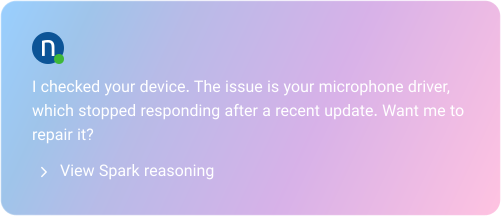
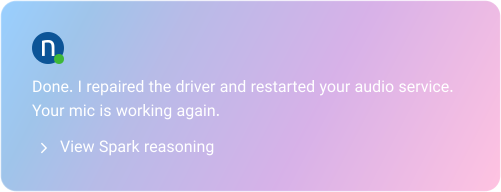
Spark resolves issues instead of deflecting them. Most IT chatbots point employees to an article or open a ticket; Spark sees the device natively through real-time DEX telemetry, diagnoses the root cause, fixes it using IT-approved actions with the employee's confirmation, and verifies the fix worked, all in one conversation. Its intelligence comes from frontier AI models orchestrated by purpose-built IT subagents, grounded in 20+ years of Nexthink expertise across thousands of organizations. And every escalation makes Spark better: when an engineer resolves an issue Spark could not, that resolution is captured so the same issue is fixed automatically next time.
Spark resolved 70%+ of issues on first contact at launch, roughly five times the rate of traditional ITSM chatbots, with typical resolutions in minutes rather than days. Autonomous resolution removes repetitive break-fix work from L1 and L2 queues, while the issues that do escalate arrive pre-diagnosed, cutting handling time for engineers. The result: support capacity grows with your organization without growing headcount, and IT talent is freed for the transformation work only humans can do.
Your IT organization does. Spark can only execute actions that IT has explicitly approved, drawn from a Nexthink-maintained library of tested remediations plus custom actions and workflows your team defines. Diagnostics run silently; any remediation that changes the device requires the employee's confirmation and runs at the approval level IT has set. Every conversation, every piece of evidence consulted, and every action taken is logged and replayable in the Spark Cockpit, and Spark acts only on the requesting employee's own device. Customer data is never shared across customers.
The Spark Cockpit in Nexthink Infinity shows adoption, self-resolution rate, escalation rate, and time to resolution in real time, with every conversation available for individual review. Alongside these operational metrics, organizations typically track ticket-volume reduction, first-contact resolution, and employee satisfaction, which are the same measures Spark's published results are built on.
Beyond resolving individual issues, Spark shows IT what employees are actually struggling with: the top conversation drivers across the organization, categorized by issue type, with full drill-down into any conversation. That turns everyday support interactions into a live map of digital friction that most IT teams have never had, so recurring problems can be eliminated at the source rather than resolved one employee at a time.
Spark learns from every escalation: when a support engineer resolves an issue Spark could not, the resolution is captured so the same issue is solved automatically the next time it appears. One engineer's fix becomes every employee's fix. Nexthink also continuously expands and maintains the action library and Spark's IT intelligence, so capability grows with every release without any retraining or maintenance work on your side. IT teams steer the improvement loop directly, reviewing conversations and approving what Spark takes on next.
Yes. Spark grounds its answers in your knowledge base and integrates with your ITSM platform, including knowledge sync, ticket creation, and service catalog awareness, so it works with the investments you already have. It's available in Microsoft Teams and Microsoft 365 Copilot, and open agent-to-agent (A2A) and handoff APIs let existing chatbots and virtual agents pass conversations to Spark mid-stream. Deployment is fast: Spark rides the Nexthink infrastructure already in place, with no new software distribution project.